
Welcome to the Repertoire Blog! This is a space where we expand on podcast topics or we riff on something yet to be discussed in “Don’t @ Me” or “Play It By Ear.” Read and follow along to get a deeper look into the minds and opinions of the Crispy Boyz.
The Science of Being Clutch
Some perform well under pressure and others don't. But why? Is the "clutch gene" an innate attribute or can it be learned? Science explains.
By Mike Silva
I'm going to describe to you two different, fictitious people in the same fictitious scenario with differing fictitious outcomes.
The purpose of this is to see how you would describe their reactions to their set of circumstances and what characteristics or traits you'd assign to each one.
Scenario: Two people are taking a timed test. There's a 60-minute allotment to answer 50 questions. Four minutes remain and each person has six questions left to answer.
Person A: To this point, Person A is confident about his performance. He knows the source material, he's sure of himself, and he hasn't let the clock impact his process of deducing his answers. This doesn't feel any different than homework from last week. He studied and practiced and actually comprehended the material ad nauseam. There's plenty of time to turn in a strong set of responses to the final six queries.
Person B: Person B is on a roller coaster. Each question welcomes either extreme confidence bordering on cockiness or it comes with a blank stare. The tougher questions make him second guess himself on how he responded to the easier questions. He's sweating, his heart rate is accelerated, and he's done the math: 50 questions in 60 minutes is about 1:12 per question. At this pace, he's got time to answer just three questions. What if I fail? he wonders. What if the ones I thought were right aren't right at all? Why did I mark "c" in four straight questions? That can't be right, can it? Dammit, now just three minutes remain!
This is a very relatable scenario. How often have we been in either shoes? Most likely we've experienced both sides of the spectrum. But how would you describe each person?
Person A is prepared. He's confident. He's unshaken. Simply put, he performs well under pressure.
Does that mean Person B is the opposite? Is he unprepared or does he lack confidence? Not necessarily. But you could say he doesn't perform very well under pressure.
Where it gets even trickier is if we try to label each one. We truly don't have any other information to jump to such a finite conclusion of assigning a label.
Consider the following possibilities:
Maybe Person A's best friend took the test earlier and gave him several answers. Is Person A then a cheater?
Maybe Person B and his girlfriend are in a fight. Maybe Person B has a close relative that's in poor health it's distracting him at the moment.
Again, we don't have enough information to make a final assessment. There are too many external factors to consider to which we aren't privy at the moment.
Let's make this even more complicated. Let's say the tables are turned. Person A is the one with the ailing relative and he's in a fight with his significant other. Person B has several answers ahead of time and is still struggling to ace this test. How do you explain this?
Long story short, this comes back to one way we originally described Person A: He performs well under pressure.
There absolutely is such a thing as being "clutch," when everything slows down and the pressure reaches a height that motivates rather than deters capability.
For years, people have been trying to figure out the science behind "the clutch gene." In sports, most prevalently, we have this conversation all the time. For every clutch player there's the counterpart: The choke.
But what predicates which side of the spectrum one falls into? Are you automatically clutch in nature or choke in nature, or is it a mix that varies per scenario?
To understand this phenomenon, we have to observe the way the brain works. But first, let's look at the body.
Science has shown that gross motor skills (e.g. running, swimming, punching) improve when pressure amplifies. Think about life or death situations, where a grandmother is able to lift a car off the ground.
Fine motor skills (e.g. typing or writing, picking some up with your fingers, throwing a ball), on the other hand, see a more complex correlation.
Performance of complex skills follows an "Inverse U" pattern: Skills improve until they reach a height, a breaking point or threshold, where they then begin to dramatically decline. Think about a pitcher, worried about runners on base instead of the batter at the plate, that locks up and throws a wild pitch.
Physiologically, when we're under an intense amount of stress, several things happen. We sweat, our heart rate increases, we may get that sudden rush of butterflies, our joints become stiff, our muscles contract, our words come out a little choppier than usual.
Think about that feeling you get when a cop pulls you over, or when you were younger and you approached a girl to ask her on a date, or your first job interview.
Now, you may not have exhibited all of the stress indicators listed out above, but to a varying degree, some of those things indeed happened. Your nerves were up. This is uncharted territory. You don't have the experience. You don't know what the outcome will be.
But fast forward just a bit. Guys, isn't it a lot easier to approach a girl now than it was when you were 12? Isn't a job interview a lot less stressful than the first one you've ever encountered? Unfortunately, seeing flashing red and blue lights is still a bit unnerving.
The point here is that of conditioning. This is where the brain comes in. Sure, approaching an attractive member of the opposite sex can still feel challenging, just like a job interview hasn't become comparable to ordering a cup of coffee, but our experiences have conditioned us to not expect the worst.
When we become more focused on the task rather than the outcome, we're able to maintain a proper focus. We're no longer worried about what could go wrong. Hell, even getting overly excited about what could go right can be enough to get your nerves to an unmanageable level.
You would think intense pressure means you'll be stronger and faster, but with less control. At most times, that seems to be true. But with top performers, the truly focused, we know that isn't the case.
Have you ever heard someone describe a great quarterback as having amnesia? What this means is great players have the ability to make a mistake and immediately forget about it.
While they definitely should learn from theirmistakes (don't force a pass into double coverage, dummy!), they're wise in moving on and not dwelling on them.
Overthinking what went wrong makes you consider what else could go wrong. Instead of focusing on the cliche "one play at a time" and being task-oriented, they think of the outcome. I hope I didn't lose us the game.
So is "clutch" something innate or can it be learned? The good old nature vs. nurture debate rears its head again.
In short, you can definitely condition yourself to become clutch. To visualize this, let's take a loot at this figure:
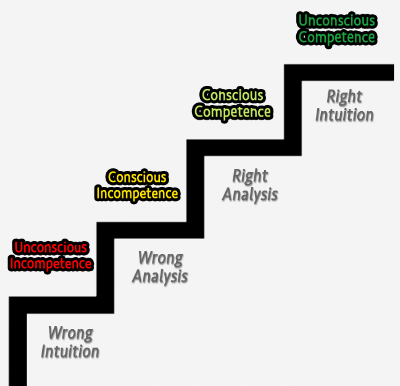
Competence Chart
There are four levels of competence:
Unconscious incompetence - You don't know what you don't know.
Conscious incompetence - You know you don't know it.
Conscious competence - You know you know it.
Unconscious competence - You don't know you know it.
The goal is getting to unconscious competence. This is when an ability becomes second-nature. Your level of mastery has reached such a height that you're not consciously thinking about the action, you're just doing it.
Think about mastering a recipe. The first couple of times you cook this dish, you're measuring everything out, timing out each step, checking constantly to see if your food is done.
The more you cook this meal, the easier it gets. It becomes an eyeball test. You can look at that steak and know when it's time to take it off the grill.
The levels of competence are quite visible in sports. A young rookie QB gets his first action under center.
He's wide-eyed and doesn't know what to expect (unconscious incompetence). He comes to find out NFL defenses are way more athletic and skilled than college defenses and he struggles (conscious incompetence).
After a couple of games, he starts to get it and as he's completing passes and winning games, he's feeling good about himself (conscious competence). Then he gets to a tough, 2-minute drill to lead his team to victory. He's calling audibles at the line because at a glimpse he's diagnosing what defense he'll see each play. He's executing each play, running back to the line of scrimmage, and driving his team down the field (unconscious competence).
Now, we can't accurately simulate every high-pressure moment and we certainly can't anticipate how we'll respond without proper experience. It's also probably not wise to seek out high-pressure situations just for the sake of practice.
That said, there are some things we can control:
Keep our eyes on each underlying task instead of looking ahead to the outcome.
If you make a mistake, learn from it and move on. One neat trick to get used to overcoming mistakes: Try doing menial tasks (brushing your teeth, opening doors, pouring water) with your non-dominant hand. You're going to be clumsy and make some messes doing so, but as a result, your psychological response to making mistakes strengthens. It also forces you to focus on tasks while making failures feel less important.
Always be prepared. You can never be too prepared.
Practice your craft until you reach a level of unconscious competence. Make it second nature.
Heartbreak In Sports: A Coping Mechanism
Sports can unify and divide like nothing else and every game has a single play that changes everything.
By Mike Silva
What a time to be alive.
The beginning of 2017 means the end of 2016, which by all accounts presented a crazy year in sports. Let's recap:
You can't say enough about Super Bowl LI. Wow. To come back from 10 points down is damn near impossible. Tom Brady did that two years ago. To come back from down 25? To put up 31 unanswered points in a total of about 25 game minutes? Only Brady.
We saw the demise and resurgence of Aaron Rodgers, the end of the witch-hunt that was #Deflategate (ashtags and the "-gate" suffix are sad reminders of the times we live in), the rebirth of the 90's era Dallas Cowboys, and a $72M contract go to a 6'8" quarterback who can't complete 6-yard passes who looks like he's starring in the next Twilight movie (don't lie, you got that one).
The NBA, having just returned from the greatest NBA story ever (don’t deny it, the LeBron James redemption tour that ended in bringing Cleveland a title by overcoming a 3-1 series deficit over a 73-win team is pure cinema) is back for another installment where we may--no, will see a trilogy of Cleveland-Golden State. The Warriors adding Kevin Durant is definitely equivalent to Han Solo being carried away in carbonite like a life-sized Hershey’s bar to end Episode V. The Empire indeed struck back. I just want to see the devastation Russell Westbrook leaves at all those that get in his way of vengeance (update: 21 triple-doubles at the All-Star break level devastation).
Let’s not forget about baseball. We saw the Chicago Cubs (hadn’t won the World Series since 1908) defeat the Cleveland Indians (still haven’t won since 1948) in the ultimate showdown of two snake-bitten franchises. From Bartman, billy-goats, and the underperforming Lou Piniella teams of recent history in Chicago to the 1997/Jose Mesa, 3-1 ALCS lead over the Red Sox in 2007 losing Tribe, the stage was set.
Being a Patriots fan right now means being on Cloud 9. No sports outcome has/can/will ever compare to the crazy comeback in Houston on Super Sunday. None will ever. But imagine being an Atlanta Falcons fan today. How must that feel?
Let's look at this year's World Series, a microcosm for both team’s histories. How fitting is it that this series went from 3-1 to 3-3, promising for another heartbreaking Game 7 for one of these teams (re: the Cleveland Indians)?
At 3-3 heading into Game 7, the obvious question that arose was "whose loss would be more painful?"
On one hand, you had Chicago, down 3-1 when all of a sudden, the series is knotted at 3 apiece. Imagine they lose Game 7 after climbing out of that deep hole. The "almost" comeback is as painful an outcome as any in sports.
On the other hand, you had a Cleveland team looking at the other side of a 3-1 series lead (nod to the Cavaliers). The pressure that mounts knowing you only need one W to seal a title can be overwhelming, especially when you consider karma had their back in the NBA. Losing three games in a row to close out a series is devastating. To be that close…
Because of the Cavaliers win in June, the city of Cleveland is still high on life. Believeland, right? Even when the Indians lost one of the most thrilling World Series Game 7s of all time, you kind of got the sense that they were OK. I have to think the emotions of Rajai Davis' three-run shot off Aroldis Chapman in the 8th inning encompassed enough to feel like a win. It has to go down as one of the most memorable moments in Cleveland sports history. A moment which, sadly, ended again in tragedy.
Sports are so captivating for the unifying quality they have alone. They can make or break an entire city’s spirit in a single moment. The emotions and sentiments they impose on us are contagious and long-lasting.
How long does it truly take to get over a heartbreaking loss? It differs for everyone. Sometimes a heartbreaking loss is almost welcome, as if it was the expected outcome all along. There’s a certain relief to it.
You don’t have to hold on so tight anymore, you tell yourself. You can let go! It’s over!
The one thing heartbreaking losses always have in common is the presence of that one play. Think of the two aforementioned instances (Bartman and LeBron’s block). In both cases, you knew the game was over. Whether it’s in an obvious, literal state (a buzzer-beater has a pretty clear finality to it) or it’s a single, tipping point play before the end, these games within the game are as emotionally charged as the final result.
For Falcons fans, it has to be the crazy Julian Edelman catch. There's no way it isn't. Maybe Donta Hightower's strip sack is up there, but at least it wasn't a freak play.
We all have our short list of such moments and five stand out for me. Before we start, here are some honorable mentions:
Note: I'm a hardcore Tom Brady, 49ers, and Yankees fan.
Honorable Mentions
The Play: Reggie Wayne’s Should’ve Been Fumble
Setting: 2006 AFC Championship Game
Outcome: Colts beat Pats, 38-34
We’d heard all year that this was it, this was the year Peyton Manning would finally get over the hump and lead his Indianapolis Colts over the Patriots and get a Super Bowl berth.
After a fast Pats start and an Asante Samuel pick-6, it was 21-3. Business as usual. Brady was going to take the Pats to Miami and beat the Rex Grossman-led Chicago Bears for his fourth Super Bowl title.
Until, slowly but surely, the Pats lead evaporated, thanks mostly to the defense falling apart and Reche Caldwell being Reche Caldwell. After it was knotted at 21-21, the Pats and Colts traded scores to get to 31-31 before the Pats scored for the last time with a go-ahead 43-yarder, giving the Colts a little over two minutes to overcome a 34-31 deficit.
Indy had marched to around midfield breaking the two-minute mark. Manning hits Wayne over the middle. He breaks free into open space, jukes, spins – the ball is out! Nevermind, right back in his hands…
The ball pops straight up in the air and right back into Wanye’s hands. Had the Pats collected the ball, turnover, and likely, ballgame. But instead, the Colts drove until they scored the game-winner, a run by Joseph Addai of all people.
You can see the entire game below or skip to the play itself at 2:05:23. While I hated the outcome, it really was one of the most exciting football games I’ve ever watched.
The Play: Malcolm Smith’s Endzone INT
Setting: 2013 NFC Championship Game
Outcome: Seahawks beat 49ers, 23-17
After taking the league by storm, Colin Kaepernick was looking for redemption. Just months after losing the Super Bowl (more on that later), the 49ers were in a position to return to the big game.
They led the rival Seattle Seahawks for most of the game. 10-0, 17-10, 17-13. A disastrous misplay in the secondary led to a 40-yard touchdown pass to Jermaine Kearse (more on him later, too) on 4th and 7, ultimately giving the Seahawks a 20-17 lead early in the 4th.
But no worries, Kap is under center. In the final minutes the 49ers stopped the bleeding. What looked like it would be a blowout was still somehow just a six-point game. San Francisco drove the ball all the way to Seattle’s 18-yardline with 30 seconds remaining.
Kap throws a route towards the side of the endzone to the usually reliable Michael Crabtree. I don’t know whether to blame Crab for a weak attempt on the catch or applaud Richard Sherman for his athleticism, but Sherman jumps up and tips the ball, right into his teammate Smith’s hands for the game-ending pick.
What ensued was an injustice to postgame interviews everywhere. Hawks win and go on to beat Denver for the title.
The Play: Jermaine Kearse’s Circus Catch
Setting: Super Bowl XLIX
Outcome: Pats beat Seahawks, 28-24!
This one comes with a caveat, as the game ended exactly how I wanted it to: in agonizing defeat for Seattle and a fourth title for Brady and the Pats. In fact, Malcolm Butler’s fantastic goalline interception would probably be number one a list of best moments of my sports fandom.
But this list is for misery, and the “what if” here (what if Butler doesn’t make that play and the Pats lose?) would be the ultimate pain. It would probably push this to number one on this list. Anyway…
This back-and-forth game saw the Pats take control, lose control, climb back from a 10-point deficit in the fourth quarter, and give the ball back to the other team with a little over two minutes to go (this always happens!).
First down at about the Pats’ 40, Russell Wilson heaves a ball down the sideline to Kearse (again with this guy). Butler, playing about as perfect pass defense as you can play, leaps up and tips the ball. It hits Kearse’s leg, then bounces around off just about every extremity of his body, before he pulls it in inside the 10-yardline.
The amount of focus it takes to make this catch is only surpassed by the amount of luck it takes to make this catch. It had scary PTSD undertones (freak catch to position a Pats loss in Arizona) until it was all for naught. Butler makes a big play, Pats wins. But what if they hadn’t? I don’t want to think about it…
The Top 5
5. The Play: Mario Manningham’s Great Catch
Setting: Super Bowl XLVI
Outcome: Giants beat Pats, 21-17
The New York Football Giants. They’ve caused me so much pain. The Manning family alone has cost Brady at least four championships, but likely, indirectly more than that.
Tom Terrific’s most recent failure to capture the elusive ring No. 4 (note: he has it now after beating Seattle) came on a déjà vu: Pats prolific offense struggling to score on a dominant Giants front four. Pats lead with less than four minutes to go. Eli Manning has way too much time to overcome a slim lead (17-15 in this case).
So what happens? 1st down near the 10, he immediately hooks up with Manningham on the sideline near midfield to start the game-winning drive. Remember, they only needed a field goal, so this play all but promises them that since it leaves them needing only about 20 for a makable kick.
They end up scoring on an Ahmad Bradshaw run of the “let them score so we can get the ball back” Patriots defensive variety. It proved to be enough. Brady got the ball back with over a minute to make it matter, but too many drops from pass receivers left the Pats heartbroken once again.
4. The Play: Wes Welker’s Drop
Setting: Super Bowl XLVI
Outcome: Giants beat Pats, 21-17
Same game, different play. Three plays before Manningham’s sure hands we saw Welker’s stone hands drop what would’ve been the game-winning play.
It’s 2nd and 11. Brady drops back and hits Welker right in the hands near the 20 yardline of the Giants. Several things happen if he holds on:
1. First, the Giants had one timeout remaining. The play results in a first down with under four minutes to go. Even if the Giants D holds on, we likely get to the two-minute warning with no timeouts left for them.
2. At the very least, it puts the Pats in field goal position. A 20-15 lead with about two minutes to go is pretty comfortable, especially knowing the other team, at this point, won’t have any timeouts to spare.
3. Knowing the first two bullet-points, you’re likely an additional first down away from just running out the clock.
4. Best case scenario, the Pats score a touchdown and take a 24-15 lead with just under two minutes left. The game's essentially over at that point.
But no, none of that happens. Welker drops the ball because of course he did. Some say Brady’s throw was off. Sure, it could’ve been better. It could’ve been thrown in stride. But you can’t argue with the fact that Welker had two hands on it. Two hands! You HAVE to catch that.
3. The Play: The No-Call
Setting: Super Bowl XLVII
Outcome: Ravens beat 49ers, 34-31
What started out as a disastrous game for the 49ers turned into a thriller.
After the second half opened with a Jacoby Jones (what’s up, Texans fans?) kickoff return for a touchdown, the Baltimore Ravens were in a commanding position to win, up 28-6 with just less than a half to play.
Inexplicably, the power went out in the Super Dome to a parade of funny memes and conspiracy theories. When power was restored, what had to have been nerves and jitters disappeared for the 49ers.
A field goal and a pair of touchdowns by Frank Gore and Crabtree cut the insurmountable lead to five points, 28-23. There was some back-and-forth that ultimately led to a 49ers possession, down 34-29, with two minutes remaining to score a go-ahead touchdown.
Five yards away from paydirt, the 49ers failed to punch it in three attempts. A combination of incomplete passes and poorly designed plays (don’t even get me started on wondering why a team predicated on a dominant run game chose to run the ball exactly zero times) set up one last chance.
I hate saying the refs influenced the final of the game, but I mean, you tell me: how is this not a pass interference or defensive hold? Jimmy Smith literally impedes Crabtree’s path with his hands and is rewarded by not being penalized.
Turnover on downs, Ravens purposely get a safety to eliminate the risk of a turnover, and a safety punt ends the game, resulting in a Ravens win. I still wonder what would’ve been if this call was actually made.
Again, the "almost" comeback hurts more than just getting blown out.
2. The Play: Dave Roberts Steals Second
Setting: Game 4, 2004 ALCS
Outcome: Red Sox beat Yankees, 6-4
Remember how I talked about the negative effects of the Bartman play on the Cubs team and how it willed them to beat themselves? The exact opposite happened in 2004 with the Boston Red Sox, and I saw it coming a mile away.
To this point in the series, the New York Yankees were the Red Sox’s daddies, as Pedro Martinez used to say. Up 3-0, the Yankees were in an undisputed position to go back to the World Series. No team had ever won a series after being down 3-0.
After crushing Boston in Game 3, the Yankees were yet again in all but guaranteed territory to win. Up 4-3 with the greatest closer of all time, Mariano Rivera, on the mound, New York was on its way to going after title 27.
Uncharacteristically, Rivera walks leadoff batter Kevin Millar. Knowing he’s slow as molasses, Terry Francona sends in Dave Roberts to pinch run. (I know, I hadn’t ever heard of him before either.)
With Bill Mueller at bat, Roberts was leaning heavily towards second after every pitch. Watching at home, you knew he was going for the steal. Everyone at Fenway had to know he was going for the steal. Hell, Rivera knew this too. And somehow, he still stole the base.
In a vacuum, you’re looking at a team down 3-0 with the tying run in Game 4 on second base against the best closer ever. Even if Boston somehow, some way wins, it’s 3-1 with Game 6 and Game 7 (if necessary) in New York. It shouldn’t have been that daunting.
But it was.
I’ve never seen such an overjoyed reaction over a stolen base in my life. You’d think they stole home to score a title-winning walk-off run. The reaction scared the hell out of me.
It was weird. You could tell they were going to rally and win the game. Ultimately, they did just that in the 12th inning.
What was even weirder is that in the following games, that Boston confidence/New York fear-for-the-worst carried over. It was concrete and tangible. You could literally feel the tension.
For that alone, as minor as it was in the grand scheme of a seven-game series, the Roberts steal was undoubtedly the turning point. It was the single moment that led the Red Sox to the only Major League series victory from down 3-0.
Damn you, Dave Roberts.
1. The Play: David Tyree
Setting: Super Bowl XLII
Outcome: Giants beat Pats, 17-14
It hurts to even reminisce on this. The Pats win over Seattle in SB49 helped make some of the pain go away, but damn, talk about disappointing.
I’m not sure how much of this scenario I need to set up. The Pats finished the regular season 16-0, becoming the first team to win 16 games in a season and the only one since the 1972 Miami Dolphins to go undefeated.
After two too-close-for-comfort playoff wins, the stage was set: David (oh, the dramatic irony) and Goliath. The 18-0 Pats vs. the “how did they even make it this far?” Giants.
From the jump, you knew it would be a close game. The Giants front four pretty much controlled the trenches the whole way. The prolific Pats offense was held in check until a Randy Moss touchdown gave the Pats the 14-10 lead with less than three minutes to go.
I’ll never forget what happened next. Ever.
A couple plays get the Giants to about their own 43. 3rd and 5. Giants ball with 1:15 to go. Eli hikes the ball, drops back seven yards, has his jersey yanked on by several Pats defenders, heaves the ball downfield, the ball gets lodged between David Tyree’s hand and his helmet, and Rodney Harrison’s usual bone-crushing hitting style goes dormant for just a moment, allowing the catch that gives the Giants the ball inside the New England 30 with about a minute to go.
You knew they were going to win after the catch, and moments later, a Plaxico Burress TD gave them the final 17-14 score they needed to win.
The circumstances easily make this the best play and best game in league history. The pursuit of perfection ended with a three point loss. 18-1 was a reality.
There are many reasons why this hurt so bad:
1. A few plays before, Asante Samuel drops what would’ve been the game-winning interception. It goes right through both hands.
2. If Eli is pulled down, it’s 4th and 12. Anything is possible, but still, clock ticking, ball on your own 35 with 12 yards to extend your season? Steep odds.
3. If Harrison hits Tyree the way he usually hits receivers or even so much as bats the ball out of his grip, it’s 4th and 5. Not an unsurpassable obstacle by any means, but still.
4. If the refs actually call what appears to be a collection of holds on the Pats defenders, it’s 3rd and 15 with the clock running.
5. If the refs call any of the ensuing defensive pass interference calls when Brady tried hitting Moss on the sideline, we may have seen an overtime game. This isn’t why they lost though.
Like I said before, because of the circumstances and the actual game itself, this is probably the best, most important, most shocking NFL game of all time. That doesn’t mean the outcome doesn’t still hurt though.
6 Biggest Surprises from Super Bowl LI
The most shocking Super Bowl in history was full of surprises. What stood out most?
By Mike Silva
All-in-all, Super Bowl LI was arguably the most exciting, gut-wrenching, nerve-racking, memorable big games of all time.
Aside from the actual game's drama, the side stories and impact on overall legacies only add to making the case for this being the greatest Super Bowl ever:
Brady's redemption tour for the #Deflategate bullshit.
Brady and Belichick's quest for the immortal and evasive title number five.
Atlanta's path to winning their first ever Super Bowl championship.
Brady playing for his mother, who's been battling cancer.
The classis unstoppable force meeting the immovable object; the league's top scoring offense facing the league's top scoring defense.
Instant classic, as they say. While the game was surprising overall, these are the thing that were least expected.
1. The Falcons pass rush
Going into the game, this was looking to be the weakest defense Tom Brady would play in all his Super Bowls. That's not knocking the Falcons, they just aren't the Legion of Boom or the Giants' perennially great front four.
A few minutes into the game, it appeared this would be the toughest Brady would ever face.
Not only did Atlanta masterfully keep the Pats offense in check with their physical man-to-man defense, the pass rush was incredible.
Brady got to take about a half breath after every snap before a sea of red flooded the pocket. What's more, a lot of it came in the interior, where the Falcons lacked the most depth.
Whether it was Grady Jarrett or old-man Dwight Freeney, Atlanta gave Tommy Boy no time to pass. Until they tired out at the end, that is.
2. Where's Dion Lewis?
What confused me the most was the lack of Dion Lewis usage in the New England gameplan.
The squirmy running back made a habit of making defenders look foolish with his evasive running abilities. So why not use him against the Falcons?
Lewis ended the game with 6 rushes for 27 yards and a single catch for 2 yards.
You can't take away from the defense's ability to eliminate a player's impact, which Atlanta did effectively. But at the same time, he was used so infrequently, it didn't matter.
Lewis was in on 17 snaps, one being the weird trick play kneel run to end regulation and the other was a missed wide receiver pass by Edelman.
Where was Lewis?
3. Rookies outperforming veterans... at first
Some of the games biggest players were either rookies or sophomores.
For Atlanta, that meant Deion Jones and Grady Jarret on defense.
For New England, it was Malcolm Mitchell and Trey Flowers.
Of course, the stars of the game had a couple years of experience, but how can you explain the Edelman/Hogan/Bennett combo, teaming up to drop so many big plays?
Now, that of course turned around in the 4th quarter and OT (let's not forget the Pats' version of the Tyree catch), but it was pretty jarring to see so many big drops.
4. Brady's pick 6
No one is perfect, not even Tom Brady.
The fact that Brady threw a pick-6 wasn't shocking in and of itself, especially when you consider how much duress he sustained all game.
What was shocking was his decision to throw the ball in that situation.
3rd and 6 deep in Falcons territory can end in either a first down (not likely as the play broke down) or you eat the ball and kick a field goal, 14-3.
You cannot, I repeat, CANNOT, turn the ball over. Brady threw what was easily the worst pass of his career. He tossed it right into Robert Alford's hands for the pick-6. 21-0.
That was a 10-point play, if you think about. Uncharacteristic for Brady.
5. Edelman's catch
For once, the Pats were on the winning end of a lucky, gamechanging catch.
What happened defied logic and physics, and while you have to credit Edelman for his focus, luck played a huge part in the catch.
Just before the two-minute warning, Brady throws a contested pass into a cluster of red jerseys.
The ball is tipped, hits Alford's leg (sweet justice!), safety Ricardo Allen's leg, Jules' hands, then bounces up out of his hands as he double clutches and comes down with the pass. Catch. Reviewed. Confirmed.
No one will forget this catch. Ever.
6. The Falcons situational playcalling
Offensive coordinator Kyle Shanahan is getting destroyed for his late game playcalling, and rightfully so.
You can't surrender what got you to the championship game by avoiding aggressive playcalling. People are afraid of the word "conservative" because it's connotation is it means "soft." That said, there's a huge difference in saying "we're not going to be conservative" and "we're not going to play smart."
After wide receiver Julio Jones' freakishly stunning sideline catch seemingly put the exstuinguished the Patriots' comeback, the playcalling came into major question.
Atlanta wisely ran on first down. They lost 3 yards, but at this point, the clock is your biggest opponent. Just kill it.
So what do the Falcons do? They choose to pass the rest of the drive. Not just quick, safer passes either. We're talking long-forming, 7-step drop plays.
What happened? A sack and a hold pushed Atlanta out of field goal range.
The ensuing punt pinned Brady at the 9, but even with 91 yards and a two standing in the way of overtime, 3 and a half minutes is a century for the GOAT.
5 Unsung Heroes from Super Bowl LI
Everyone will remember Tom Brady's late game heroics, cementing his legacy as the league's greatest quarterback of all time. But who else deserves some credit? Here are some unsung heroes.
By Mike Silva
What. A. Game.
I don't need to get into details about the game. I'm sure 90% of all your water cooler conversations at work today revolved around the unforgettable Super Bowl LI.
If you were under a rock or you blacked out from celebrating an Atlanta win midway through the 3rd quarter and just emerged from a drunker stupor, here's the quick recap:
Atlanta Falcons linebacker Deion Jones continues his run of excellent defensive play by stripping New England Patriots running back LeGarrette Blount in the second quarter. Falcons go on to score and take the lead, 7-0.
After more futility from the Pats offense, Atlanta gets the ball and scores again, 14-0.
Tom Brady marches New England down near the redzone, hoping to cut the deficit to one score or 11 points at the most. Disaster strikes. An uncharacteristic pick-6 puts the game at 21-0.
Pats drive down and eek out a field goal going into the half down 21-3.
Back-to-back punts leave the Falcons with another scoring drive, putting the game seemingly out of reach at 28-3.
Brady gives the Pats their first touchdown drive after both a 4th down conversion and a 15-yard scramble. After a missed PAT, Pats still down 28-9.
After only managing a field goal, the game is at least in two-possession range. Pats linebacker Donta Hightower blindsides Matt Ryan and forces a huge turnover deep in Falcons territory.
Brady hits Danny Amendola for a touchdown. James White brings back flashes of Houston's last Super Bowl in 2004 with a direct snap rush up the gut. 28-20.
Falcons drive down the field and stall. Questionable play calls end the drive with a punt to the Pats.
Lucky catches finally make their way in helping instead of hurting the Pats fate. Julian Edelman reels in a tipped pass around the two-minute mark to setup what would lead to a scoring drive. A TD run up the middle by White followed by a screen pass for two to Amendola, tie ballgame.
The first overtime Super Bowl ever. Coin toss. Pats ball. At this point, was there any doubt?
2nd and goal from the one. Brady tosses the ball back to White. White cuts outside, bangs into a couple of Falcons defenders, dives for the endzone and brakes the plane, almost levitating as he sails into the paint. 34-28. Patriots pull off the greatest Super Bowl comeback ever.
So what made this possible? Of course, the MVP of the game (Brady) turned around what looked to be his worst professional outing ever. Edelman and Hightower made probably the two biggest plays of the game. But who else made a difference?
1. James White
Go back and watch the highlights. This NFL entry is about 20 minutes long but it really abridges the game nicely.
Every single time the Pats were backed against the wall, who bailed them out? James White.
Not only did he break a record with his 14 catches, tallying 110 receiving yards, he also added two rushing scores (including the game winner), caught the Pats first TD of the game, and Kevin Faulked into the endzone for the pivotal two-point conversion that made this a one possession game.
Brady felt like White was the MVP, as did Blount. Maybe he'll get Brady's MVP truck, like Malcolm Butler did two years ago.
2. Danny Amendola
Dola was another big player when it mattered. He caught the TD that prefaced the Faulk-like direct snap 2PAT that brought this to a one score game.
He caught the two-point attempt that tied the game (even though it would've been a free play since Atlanta jumped offsides).
Probably his biggest contribution, and one that gets overlooked, is the 4th down catch he hauled in to extend the Pats first TD drive. If he drops that, Falcons take over on New England's 40, up 28-3 with about 23 minutes left to play. Game over in all likelihood.
Don't forget about his big catch in OT either. It was more about the throw by Tom, but it was important nonetheless.
3. Trey Flowers
The preseason is just the preseason, but ever since August, defensive end Trey Flowers has been impressing everyone who's kept a close eye on the Pats.
His 2.5 sacks led the team for the game, momentum he began developing throughout the entire postseason.
No play was bigger than his 2nd down sack of Matt Ryan late in the fourth quarter, which led the domino effect of knocking Atlanta out of game-clinching field goal range.
You'd have to think Flowers becomes a mainstay on the team with Jabaal Sheard's impending free agency upon us.
4. Malcolm Mitchell
The young guys really came to play in the big game.
While the stats aren't awe-inspiring (6 catches, 70 yards), rookie wide receiver Malcolm Mitchell was a rock when the team needed him most.
In the 4th quarter, Mitchell's trusty hands were called upon often by Brady. In the game-tying drive, Mitchell even catches a pass after he fell to the floor!
What makes this even better is Mitchell's background. He's written a children's book, was a 4th round pick in this year's draft, and somehow only missed a month of gametime after a nasty dislocated elbow in a meaningless preseason game.
5. Grady Jarrett
I didn't want to snub the Falcons entirely here. In all honesty, they outplayed the Pats and were maybe the better team.
There are too many players to give credit to, but none more than defensive lineman Grady Jarrett.
Jarrett came into the game with 4.5 career sacks and added 3 in the big game alone. His interior pressure on Brady brought many Pats fans nightmare flashbacks to Super Bowls past.
Had Jarrett not been in Brady's face all game, this is likely a blowout the other way.
Miami Heat: Public Enemy No. 1
Every sport has a team that everyone loves, hates, or loves to hate. What makes the Miami Heat fit into this category?
By Mike Silva
Every sport has a team that everyone loves, hates, or loves to hate. What makes the Miami Heat fit into this category?
I'm not breaking news or telling you anything you don't know by saying the Miami Heat are the NBA's most polarizing team.
They've clearly taken over the Los Angeles Lakers spot as the team everyone loves, hates, or loves to hate. Or hates to love. I don't know, but you get the idea.
It got me wondering why, aside from the obvious. Unless you're a moron, you have poor memory, or you just don't watch professional basketball, here are just a handful of things the Heat has done to put a target on the team's collective back.
1. The Decision.
This isn't so much a team thing as it was an individual thing, which I think makes it worse. Sports fans will likely never forget that night in July where LeBron James, the most coveted 2010 free agent and de facto "Chosen One," was to decide where he would play the next couple of years in his already religiously monitored career.
The rest, as they say, is all history. James broke up with his first love and essential hometown, Cleveland, on national television, with no heads up or hinted at inclination to basically divorce his commitment of seven years to go play with his boys.
Cleveland could do nothing but watch, and bear "witness" to what happened.
He basically turned the Cavaliers into the Jennifer Aniston to his Brad Pitt. He left the small town type girl with that humble charm for the sexy, exotic, borderline poisonous, Angelina Jolie, i.e. Miami. It's not like the city of Cleveland wasn't already the sports equivalent to Aniston, in that there's always this brittle hope that the city has a chance at success and a long-term commitment with a star, only to be brought up to the point of fruition and then slammed right back down to the lonely cellar. Must be rough.
Cavs fans were obviously hurt by their savior, their Chosen One, leaving the team he single-handedly brought to relevance and contention, but the rest of the NBA fans hated not that he left, but the way he did it.
2. "Not one, not two, not three…"
As hated as "The Decision" was, the immediate celebration thereafter REALLY rubbed people the wrong way. James, Dwyane Wade, and Chris Bosh (the third wheel/co-conspirator) danced around on stage, wearing their new Heat threads, flexing and acting a fool for Miami. James then went on to say the Heat would win, "Not one, not two, not three, not four, not five, not six, not seven…" NBA titles.
Charles Barkley called it all kinds of things, namely "silly," and of course, "turrible." If you haven't seen it, you MUST. You'll surely hate them a little bit more for it.
3. The sympathy train frequents Miami.
James, previously the NBA's good guy and hero, obviously wasn't ready to be dawned the "bad guy" and villain of the league. He begged for sympathy any way he could without saying, "Please like me again!"
Any time the Heat would lose a game, he'd let it out on some media outlet. He'd say things along the lines of "now everyone's happy since were losing," or "no one wants us to succeed," or "I'm the bad guy." Again, just paraphrased, but Wade and James sung that song like it was a No. 1 single, which of course got people sick of hearing their incessant whining. Hey, if you ask for a rainy day, you better have an umbrella with you.
4. Mocking a sick Dirk Nowitzki in the NBA Finals.
As if Wade and James hadn't done enough already, they thought it would wise, or funny, to mock the ailing Nowitzki during the 2011 Finals. Either they thought he was faking or milking a slight cough, but they were intent on letting people know they thought it was lame with their tomfoolery.
The Dallas star struggled through the flu and came up with some late-game heroics (kind of the story of the postseason) to tie the series at 2-2. Dallas didn't lose another game, and Nowitzki was tied in with the all-timers.
He also drew comparisons to Michael Jordan (because of the Finals "flu game"). Ironic that Dirk drew the MJ comparisons, as they now have something in common, not LeBron.
5. We have to return to our measly lives.
To make things EVEN WORSE, if seemingly possible at this point, the Heat were sore losers and cried about losing a title they all but had locked in a Game 2 choke job. Literally, Bosh actually cried walking back to the losing locker room.
I'm not sure Wade and James were more pissed about losing, or the fact that most of America was happy they lost. James let it all out, in classy and professional fashion. (Obvious sarcasm).
"All the people that were rooting on me to fail, at the end of the day they have to wake up tomorrow and have the same life that they had before they woke up today. They have the same personal problems they had today. I’m going to continue to live the way I want to live and continue to do the things that I want to do with me and my family and be happy with that. So they can get a few days or a few months or whatever the case may be on being happy about not only myself, but the Miami Heat not accomplishing their goal. But they got to get back to the real world at some point."
He really has no room to be a sore sport. After all, his poor play and absence in the fourth quarter of games led them to lose.
So, not only is he whining about losing, and everyone's elation with it, he proceeds to belittle the average Joe and his seemingly meaningless life. And he gets to go on with his life: rich, famous, partying in South Beach. Very sportsmanlike.
6. This isn't really a reason to hate the Heat, as much as it is my personal issue with the way things have fallen into place.
Notice throughout this piece I've referred to the dynamic duo as "Wade and James" and not "James and Wade." This is maybe the biggest issue I have with the two.
Separate, I loved both Wade and James. They were some of my favorite players. Together, I can't stand them. From their whininess to their sense of entitlement, to their arrogance, to their feeling that people owe them something, I'm sick of them.
But more importantly, with the two of them together, Wade has kind of emerged as the alpha male. After all, Miami was his city first, and he's the one with the title. James just followed, something we've never seen him do before, his friends to Miami.
As a fan of NBA lore, watching James defer is the most painful part of this experiment. His legacy, as we the masses ideally had it, has withered before our eyes. We wanted him to be the "Chosen One," the next Michael, this generation's greatest. We wanted him to be Batman, and watch Robin and Nightwing follow him to wherever his destination may be. Nobody wanted LeBron to be Robin. Nobody.
But again, this isn't a reason to hate him or the Heat, and it's really a selfish reason to dislike his choice. Maybe James would prefer to be the Magic Johnson. That's not a knock at all. Magic is one of the league's greatest of all time. But I know most people feel how I feel. I wanted the next MJ, or at least something like it.
Again, that's not accounting for James' wants, and essentially it's itemizing him as a thing rather than person. It is, after all, his life to live. But his joining Miami single-handedly removes him from talks of being the greatest ever, or even being the "guy," the No. 1 option on his own team. But, whatever.
Seeing him struggle in the clutch hurts to watch, too. He was chided for passing too much even in Cleveland, and deferring in crucial moments, but people sort of overlooked it and called him a good teammate. Now, the tables have turned, and being a good teammate is replaced by words of hate. The likes of "scared" and "choke artist" are what we've grown accustomed to hearing in James' days in Miami.
After transcribing all that, I noticed a key element to every entry I put, a consistency, if you will.
LeBron James was at the center of each and every reason why people hate the Heat. There's no two ways about it. There's no denying, he's the best player in the league right now, even if it means you have to take crunch time out of this judgment.
Is he the main reason people hate the Heat? What is it that we really despise about the team? Supposedly, time heals all wounds, and at this point, you'd think people would let up a little bit about Miami, but that's not the case.
It got me to thinking, what is it people hate so much about this team? I decided to make a checklist, and compare them to other teams across the big three sports people love to hate.
If you're wondering how your team measures up, just use this guide. Let's take a look:
1. A player that everyone hates.
When people bring up the New York Yankees, most people scowl or roll their eyes. When asked what they hate most about the Yanks, the top answers always seem to be a) their payroll, b) the late George Steinbrenner, and c) Alex Rodriguez.
Nothing gets people's panties in a wad like hearing about A-Rod. No matter what he does, people view it in a negative light.
He does steroids, people get pissed, reasonably so. He plays well, people get pissed, reasonably so (if you hate the Yankees). He plays poorly, people get pissed, which makes no sense (unless you're a Yankees fan). He dates Madonna, people get pissed, which makes no sense (unless you're grossed out by 60+-year-old women tonguing an athlete in his mid-30s). Cameron Diaz feeds him popcorn at the Super Bowl, people get pissed. What?! Why?! Shouldn't he be applauded, or earn some kind of player points for that? Guess not.
Even the Lakers have this going on with Kobe Bryant. I can't stand the guy, but I do feel for him. He scores 81 points, which is truly remarkable, and the first thing people ask is, "Yeah, well how many assists did he have?" He scores eight points, but has 12 assists and 15 rebounds, he sucks. He shoots too much, he doesn't shoot enough, he's a ball hog, he's an asshole. While most of this is true, the guy doesn't get a break. Ever.
Granted, there's the whole Denver sexual assault issue, and the fact that he quite obviously quit on his team against the Phoenix Suns in Game 7 in the 2007 playoffs, but still. He's usually public enemy No. 1.
You can say the same with the Dallas Cowboys and Tony Romo. He doesn't get it as bad as Bryant or A-Rod, but he gets his fair share.
The team loses, it's always his fault. The team wins, it's because of somebody else. Admittedly, I've been known to be critical of him, because I find him pretty overrated, and he ALWAYS chokes in the big moment, but dude can't catch a break, either. He's really not that bad, but the American consensus is that he sucks. Even his own fans rip Tony "Oh-no."
And what about New England Patriots quarterback Tom Brady? All he does is exhibit damn-near perfection, and date a Victoria's Secret model.
Now moving on to the Miami Heat.
Not only does the team have a player everyone hates, you can argue they have three.
James is the obvious leader in this category, but Wade by far doesn't get off easy.
Even Bosh gets some looks here. I really don't have much of an issue with him, at all, but some people view him as guilty by association. It was crazy how happy people were when they saw him crying on national television.
Verdict for the Miami Heat: A player that everyone hates [X]
2. A coach, GM, or other authority figure everyone hates.
The Yankees had Steinbrenner, who would fire and re-hire anyone. He'd break the bank on any player he wanted and got his way, whenever, and, really, however he wanted.
The Lakers had Phil Jackson, whose 11 titles lead all NBA coaches. The debate over Jackson is that he could only win titles with the best players, i.e. MJ and Pippen, Shaquille O'Neal and Bryant. Some say he's the greatest coach ever, while others say he's the most overrated coach ever.
The Cowboys have Jerry Jones, who is the totalitarian leader of the team. Owner, GM, hell, basically the coach, too. Some say he even acts as team mom, but this is subject to debate.
The Patriots have Bill Belichick, arguably the greatest football coach of all time. A guilty member of the Spygate scandal, Belichick invites animosity with his strange, "plain-jane" approach to interviews, his savant-like understanding of the game, and his now infamous hoodies.
This is where the case with the Heat finds a gray area. I mean, do we really hate Pat Riley? Some do, some don't. Do we really hate Erik Spoelstra? How can you hate a video guy turned head coach? Some people say his inexperience, or the appearance of inexperience, with this experienced, win-now roster don't really go together. But is that a reason to hate him?
Either way, when these two open their mouths, most people dislike what they have to say.
Let's chalk this one up to a push.
Verdict for the Miami Heat: A coach, GM, or other authority figure everyone hates [1/2 X]
3. A big market, or overall city people just seem to despise.
The Yankees play in the big apple. This is the pinnacle of arrogance and the blowhard capital of, maybe, the world. Being the top market, you're bound to reel in some haters.
The Lakers play in L.A., the consensus utopia of the United States. Nonstop, we hear about how great the weather is, how beautiful the people are, how awesome and rich everyone that lives there is. How can you NOT hate a team that seems to embrace all of this at once?
The Cowboys play in Dallas, Texas. Because of its independence, arrogance, and Southern charm, Texas gets a LOT of haters. We're all stereotyped as horse-riding, barbecue-eating, snuff-chewing hicks. Throw in the cowboy-hat toting, rich oil tycoons, and Texas is just begging to be hated. Dallas is one of the top two markets in the state and has good teams in all the top three professional sports, so this adds to the cause.
The Patriots play in Foxborough, but the team is, by default, Boston's team. What's not to hate about Boston? How is it possible to have the small-town feel, but at the same time be populated by arrogant, rich assholes? The Red Sox EXEMPLIFY this with their "we're the anti-Yankee, the cause against the evil empire, support us! Never mind our payroll is just barely less than the Yankees, or that we, too, exude cockiness." The contradictions are ridiculous.
Miami has a little bit of all of these. The city is a party mecca, most of the people are rich, it's a top-tier market, pretty good weather, the inhabitants are arrogant.
Many athletes decide to play in Miami just for the partying and proximity to South Beach alone.
While all these places are nice to visit and probably even better to live in, for those that haven't been there or probably never will, the negative sentiments only pile on.
Verdict for the Miami Heat: A big market, or overall city people just seem to despise [X]
4. An obnoxious fanbase.
Like I said earlier, New York is basically the blowhard capital of the world. Why? Because the fans never shut their mouths. Ever. The Giants were bragging about a Super Bowl before they even beat the San Francisco 49ers, and they won't shut up about this one until next February. Hell, they still talk about Super Bowl XLII. Yankees' fans are no different.
Lakers fans beat you over the head incessantly about how awesome their team is, and how great it is to be a Lakers fan. They also actually think Kobe Bryant is comparable to MJ. Absurd, isn't it?
Cowboys fans overdo it more than any other fanbase, ever. They don't shut up about how many championships their team has, nevermind the 49ers are their equal and the Pittsburgh Steelers actually have more, nor the fact that they haven't won but one playoff game over the last 15 years. They'll remind you how their team is the best, even when it clearly isn't, and how other teams just cheat. Ridiculous.
Patriots fans mostly reside in Boston, like I said before. All the reasons to hate them, I said above.
The peculiar thing about Heat fans is that they barely exist. Not in Miami, anyways. It's said that the seats don't fill till near halftime, and South Beach itself is a better attraction than the Heat.
What's worse is how the fans are fair-weather fans, i.e. they only exist when the team is doing well. That may well be the most hatable thing of ANY fan base.
Verdict for the Miami Heat: An obnoxious fanbase [X]
5. A bandwagon following.
Just about everyone you know has a Yankees fitted, even if he/she couldn't name one player. People who don't watch baseball will tell you, when asked, the Bronx Bombers are their favorite team, just because.
The same can be said of the Lakers. Somebody's got a Lakers snapback somewhere in their room, just because that's the "in" thing to do.
The Cowboys not only get bandwagon fans at their finest, but they even have an entire extra country backing them. In case you didn't know, Mexico's unofficial NFL team is the Dallas Cowboys. This also applies with basically every bordertown in existence.
The Patriots don't seem to get as many bandwagon fans as the teams listed above, but that's mainly because everyone thinks Bostonians are assholes, so screw them. Not my feelings, but usually, that's the consensus.
The Heat are no exception to weak bandwagon fans. The home city, Miami, is already full of fair-weather fans, and the rest of the country is no different.
There are countless tweets and Facebook posts populating my feed, full of malarkey about "That's right! My Heat won tonight! What's up, bro?! I told y'all!"
Yes, your Heat, the same team who, just the season before, were led by D-Wade and his tenacious supporting cast of Udonis Haslem, Mario Chalmers, and the great Michael Beasley. I forgot, you sure were repping "your" team back then.
And yes, you "told" us. Told us what, that they'd be good? Any mentally challenged child or idiot that doesn't know the difference between the Heat and the Dolphins could logically tell you that combining three players who are the best, or at least in the top five, at their respective positions could anchor a winning team. Bravo!
Verdict for the Miami Heat: A bandwagon following [X]
6. Frontrunners on the roster.
By this I mean any player who puffs his chest playing for the league's nastiest team, who thinks he's hot stuff because of the talented committee around him, not because of his accomplishments, who would whimper like a wet dog in the presence of Michael Vick if he were traded to the Washington Wizards.
Every elite team has at least one or two of these players on the roster. You know the type: he talks an unbelievable amount of noise, boasts about how good his team is any chance he gets, starts faux fights with other teams, where he barks in an opposing player's face, backs off when the other player shoves, and only starts swinging and exhibiting his toughness when one of his teammates decides to hold him back. I hate this guy, and you do, too.
The Lakers could've taught a class on this type of player in the Shaq and Kobe heydays. Rick Fox would've been the Dean of this college, and Derek Fisher, Devean George, and Brian Shaw would've been his department chairs.
With baseball, this is a little tough to judge, so it's hard for me to point these players out with the Yankees. Besides, they've had a bigger history with stars coming to New York, choking, leaving the team, then somehow rising back to stardom (Carl Pavano, Xavier Nady, Javier Vasquez, A.J. Burnett, Ivan Rodriguez, Bobby Abreu, the list goes on).
The Cowboys have a handful of these characters, too. Terrell Owens was their biggest star, to this accord. Although he actually had a lot to do with their winning, he was essentially the cause of their recent demise.
The Pats had Brandon Meriweather, who got in so much trouble with the law, you'd think he played for the Bengals. He also took on some fines for rough hits.
When it comes to frontrunners in the NBA, Miami leads the league in this stat. Where were Chalmers and Haslem before James and Bosh joined the team? Why do they have such a fiery competitiveness only now, when they have the big boys on the block, but were about as tenacious as a chihuahua before then? And what about Mike Miller? He got into several almostscuffles in the Finals, yet he was really just mailing it in for a paycheck out in Memphis and Washington.
When it comes to people talking noise because they know whose got their back, the Heat take the cake. Let's see how demonstrative Haslem and Chalmers would be if they went to Charlotte.
Verdict for the Miami Heat: Frontrunners on the roster [X]
7. Success.
What's the point in hating a boisterous, arrogant team with an annoying, mob of a fanbase if the team sucks?
Hello, why do you think animosity towards to the Cowboys has died down?
The Lakers have won 16 NBA Championships, second only to the Celtics, and remain a title threat in the foreseeable future.
The Cowboys have five Super Bowl titles, tied with the 49ers, only behind the Steelers' six.
The Patriots have just three, but they've all come in the last 10 years, and they were a few flukey plays away from having five, all in this decade alone.
The Yankees? Haha. Why even ask? They have 27 World Series titles, more championships than any American franchise in any sport. They won one just in 2009, and look poised to get another this year.
This is where the Heat are lacking. Though they won in 2006, this was before they were the monster they were today. In fact, when they won, they had the lovable Shaq, a young, fiery Wade, and a bunch of other veterans who didn't win rings anywhere but Miami.
But they were humble, and they took down the Mavs and their cocky owner, Mark Cuban, after being down 2-0 (and several Wade heroics away from being down 3-0).
Since the inception of this new Heat regime, the team has gone 86-32, lost a NBA title, and looks like the favorite to win the next couple of Larry O'Brien trophies. That's pretty damn good, but until they win a title, you can't really dawn them a successful unit.
The sample size is VERY small, however, as they haven't even been together a full two seasons, and are playing in a shortened lockout year. Either way, they don't qualify for this yet, but the verdict is still out.
Verdict for the Miami Heat: Success [incomplete]
If you're wondering how your team measures up, just give a point per check on this list. I'd say anything above 75 percent is a hatable team, and anyone over 90 percent is downright resented.
Going over the checklist, you'll see the Heat scored 5.5/7, which is about 79 percent. Something tells me after a few seasons, they'll be at a full 7/7, meaning they'll win a few titles here and there, and at some point, either Riley will come down from the owners box to coach again, or Spoelstra will become an egotist because of his success at the helm of this team, as if even I couldn't coach a team with James, Wade, and Bosh to a title.
While a true review of the Heat remains incomplete, it's safe to say they're the NBA's team to hate. Just ask Kobe. While he embraced the villain role to the fullest, I bet it's a relief knowing he and his team are no longer Public Enemy No. 1.
That title belongs to the Heat. That is, until LeBron goes back to Cleveland.
BCS, FBS, and other inferior acronyms explained in logic
College football blows and the NFL is way better. Read more to find out why.
By Mike Silva
Before I nosedive into this post, I will open with a hypothetical situation.
The American, media-captivated person you are, walk into a Best Buy, or any electronics store for that matter, to pick up a TV.
A store associate approaches you, engages you, sells his pitches on various televisions, and helps you narrow your selection down to two tubes.
TV 1). A 42" LED 1080p Samsung. Has a bajillion HDMI inputs, 240 Hz refresh rate, can stream Netflix, you name it, it's got it.
TV 2). A 26" LCD 720p Dynex. Has two HDMI inputs, 60 Hz refresh rate, can't connect to the internet, and to top it off, is an open-box item.
Here's the catch: each TV is being sold for $350. You're exclaiming, "WHAT?!?!?" to yourself as we speak. Err, as you read.
Which do you choose?
Uhh, derrhh. TV 1, over and over again.
Now that we've established this, a logic is born. When two items are readily available, at the same price or accessibility, any sane person would choose the better product, right?
So with that in mind, please explain to me why anyone would say they're a "college football guy" over being an "NFL guy"?
It's nonsense. The only foreseeable scenario I can possibly understand is if someone personally went to a big SEC school, and he/she A.) has no home team to root for in their current residing city, as in Tuscaloosa or Auburn, B.) is a fan of horrendous NFL franchises like the Jacksonville Jaguars or St. Louis Rams and therefore has to watch college ball to fill the holes in his/her heart, or C.) he/she chose TV 2 in the above hypothetical, rendering them incapable of grasping logic.
Here are some simple reasons why the NFL is better than the NCAA, with some simple logic.
If everyone who plays college ball has played in high school, but not everyone who played high school balls goes on to play in college, then the logical conclusion is that college football is the better product.
Using that same if/then, look at this: If everyone who plays in the NFL has played in college, but not everyone who played college ball goes on to play in the NFL, then the logical conclusion is that the NFL is the better product.
You don't need logic to see that, though. I mean, David Carr, Tim Couch, Ryan Leaf, Jamarcus Russell, and the likes of many other NFL busts sure did make football look easy in college. How did it work in the pros? Eric Crouch didn't even really try.
Easy, right?
NCAAF Purist: But Mike, what about pride? College boys put it all on the field for pride, not for a paycheck.
Mike Silva: Technically, the reason they put it all on the field every week is for the mere opportunity to play in the NFL, where they can continue to put it all on the field for a paycheck. And who's to say they aren't being paid? Just because the University isn't footing their bills, which, if they are a damn good player, odds are the University is footing the bill, then there are crooked boosters and such giving improper gifts to these players. So actually, yes, they are playing for a paycheck. It just hasn't come yet.
NP: Look at DeSean Jackson. He doesn't put it all on the field. He's holding back, hurting his team and his image, just because he didn't get a restructured contract. That would NEVER happen in NCAA football!!
MS: No, because players aren't paid, but that doesn't mean there haven't been players quitting on their teams, or fleeing consequence. Look at Terrelle Pryor. Though I don't think he should have been punished for basically eBaying his own jersey, he did skedaddle from Columbus the second Jim Tressel was thrown to the wolves. He didn't stay and serve his suspension. Roger Goodell did extradite that in a way, but still. And what about Maurice Clarett and Mike Williams? They knew they wouldn't be taken in to the NFL so young, so why risk leaving your team stranded?
NP: How do you explain the divas in the NFL? There aren't any T.O.s or Ochocincos in the NCAA.
MS: What's wrong with the T.O.s and Ochocincos in the NFL? It sucks for them to be on your team and watch it sink like the Titanic, but isn't drama what really makes sports what they are? Isn't this the same country where shows like Jersey Shore, the Real World, and all those crappy Kardashian shows thrive? Please.
Here are some other reasons why the NFL is better.
Explain the BCS. For those that don't know, the BCS of FBS football (which accurately stands for the Bull-Crap System of F*#$ing Bull S4!+ football), arbitrarily chooses who the best teams are, based on a computer.
Never mind playoffs, or a chance for the lesser Boise State or Houston teams to actually play against the LSUs and the Alabamas of the world. Nope. They are cursed by the weak schedule in front of them. They merely handle business, win damn near all their games, and settle for a minor, yet albeit reputable, bowl game. No chance at a national title because of the schedule and weak conferences ahead of them, things they can't really control.
Sweet.
How about the fact that college players can only play in their league for four years max?
If a team is lucky, and they somehow put together all of their best players at the exact same time, and fate throws them a bone by making these players stay the full four years to graduate over leaving a year early, which unless your Andrew Luck, doesn't happen, then at the end of these four years, this school has to completely rebuild from bottom up.
That sucks.
Why watch a league, where realistically, each team is in rebuilding mode every two to three years? That doesn't happen in the NFL. At least not on a two to three year basis.
Here's my final selling point.
When was the last time you've ever heard so much speculation or talk about minor league baseball?
"Hey man, I can't wait to watch the Iowa Energy and the Reno Bighorns duke it out in tonight's game! Should be a thriller, a real edge-of-your-seat showdown!!"
Those, by the way, are two NBA D-league teams. Catch my drift?
I don't think I've ever heard anyone try to sell me on the D-league being more compelling than the NBA, nor have I wanted to go to an El Paso Diablos or Round Rock Express game over seeing that dismal team playing in Minute Maid Park. Yes, I would choose even the Houston Astros over any minor league play.
Why? Simple. Because I like to watch the better product whenever given the chance.
Now, if you live in Canada and can only watch the CFL, alrighty then fella! If you live in Stillwater, Oklahoma, and don't have a TV, go ahead and see your OK State Cowboys, champ!
Don't get me wrong, it's okay to watch college football. That is not a sin. You have to do something with your Saturday afternoons, after all. But it is a sin to declare college football better than the NFL. Ever wonder why God's day is Sunday?
Thought so.